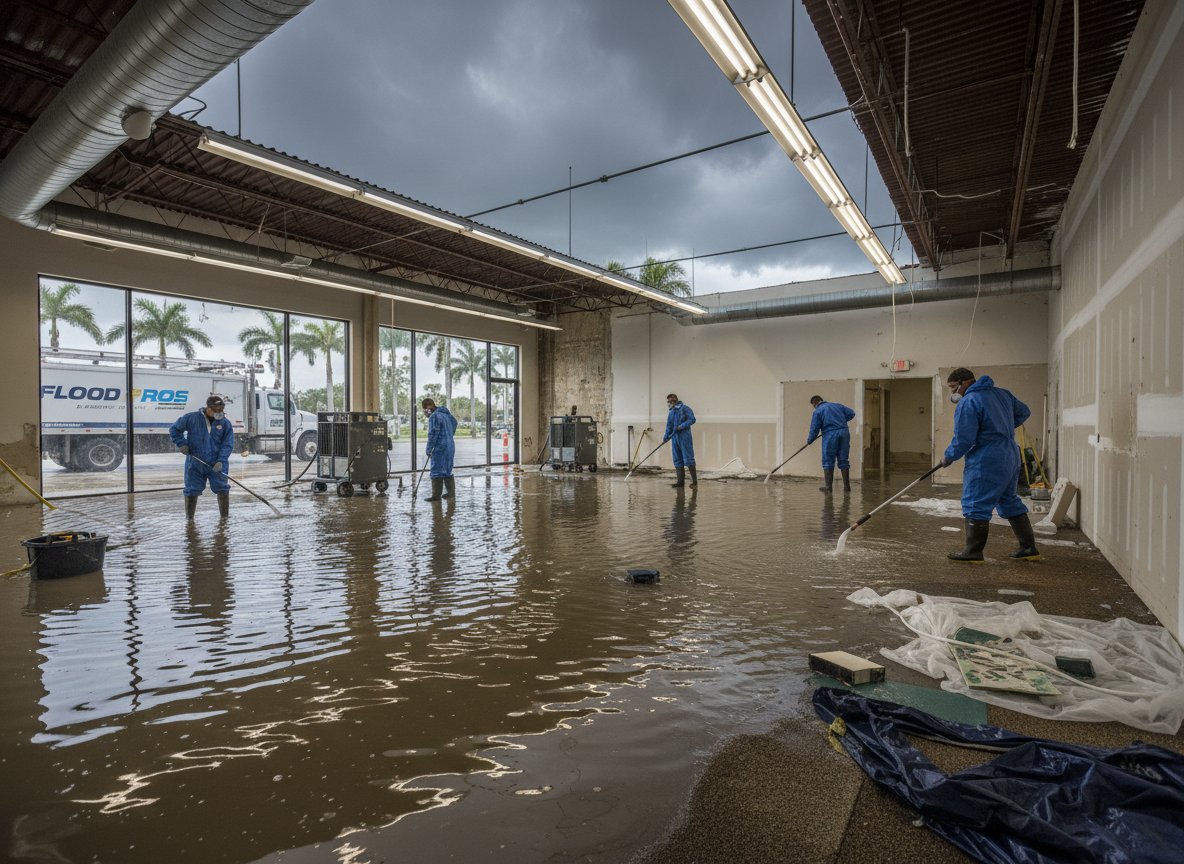
Storm damage in Fort Lauderdale is usually a slow reveal. The wind passes, the street drains, the power comes back, and then a ceiling starts to sag over a hallway two days later. The water got in during the storm through an opening you cannot see from the ground, and it has been spreading through the ceiling cavity since. By the time the stain appears, the insulation above it is heavy and the drywall paper has already begun to break down.
Why Fort Lauderdale owners call us after a storm
Storm work is mostly a sequencing problem. Water has to be stopped before anything can dry, the damage has to be recorded before temporary repairs hide it, and the repair has to wait until the structure is dry. Getting that order wrong is what turns a manageable storm claim into a demolition.
We document before we close anything up. Photographs of the opening, the wet material and the readings are taken before a tarp, a board-up or a patch goes on. Once a roof edge is covered, the evidence of how water entered is gone, and that record is often what an adjuster asks for first.
We separate what the storm did from what was already failing. A roof that was near the end of its life and a window that was never sealed properly are different problems from wind damage. The scope says which is which, without deciding what your policy covers.
We work to dry, not to a calendar. Storm season stacks jobs up, and the temptation is to pull drying equipment early to start the next one. Readings decide when equipment comes out here, and the same points are measured until they match the dry standard.
We know the local failure points. Window and door openings, roof valleys and penetrations, lanai tie-ins, and groundwater against a slab are where Broward County storms get in. That list shortens the search when a ceiling is stained and nobody saw the leak happen.
What storm damage work should cover in Fort Lauderdale
A storm is not one event in a building. It is wind pressure on the envelope, rain driven sideways into openings that are designed for rain falling down, debris on the roof, and a ground that is already saturated before the next band arrives. A crew that only pumps water out of a room is handling the smallest part of it.
We start with the entry point. That means reading the building envelope and the interior together: the window head and door track, the roof valley and the flashing around a vent, the tie-in where a lanai roof meets the house, the soffit under a deep overhang. Wind-driven rain does not respect the same paths as a plumbing leak, and the stain is often on the opposite side of the room from the opening.
We treat drying and repair as one sequence with a clear boundary. Extraction, removal and structural drying are our work. Closing a roof, replacing a window, rebuilding a screen enclosure and repainting are not, and we name those hand-offs in writing so nothing sits half-finished while you wait.
We document for the claim while we work, not afterwards. Photographs of the opening before it is covered, readings at marked points, the source we found and the material we removed, in a sequence an adjuster can follow. If a tarp or board-up is needed to stop the next rain from undoing the drying, we say so on the first visit rather than after the second storm.
And we read the building in front of us. A 1950s block house with a low-pitch roof and jalousie-era openings behaves differently from a 1980s two-storey with a truss roof, a stucco band and a second-floor balcony. One needs the wall cavity read from the outside; the other usually sends water down through the ceiling plane first.
Why storm damage in Fort Lauderdale cannot wait for the adjuster
The Atlantic hurricane season opens on 1 June and closes on 30 November, and the storms that cause the most interior damage here are not always the ones with a name. A slow-moving system that parks over Broward County for a day can drop more rain than a tropical storm, as Fort Lauderdale saw in April 2023 when more than 20 inches fell in a matter of hours and water entered homes that had never flooded.
South Florida's ground is already close to capacity before a storm arrives. The water table sits high, the canal system is managed to move water out, and a sustained rain event fills the swales and the drainage channels faster than they can discharge. Once the ground is saturated, water has nowhere to go but sideways, into the slab edge, the garage, the lanai and the lowest door in the house.
Inside the building, the clock is different from a plumbing leak. Storm intrusion often wets a large, shallow area: the top of a wall, a ceiling plane, the underside of a roof deck, the insulation behind it. That is exactly the geometry that stays damp longest, because air cannot reach it. Warm, humid air plus wet paper-faced drywall is the condition mould needs, and the smell usually arrives before anyone thinks to call.
Then there is the next storm. A damaged roof, an open soffit, a torn screen panel or a window that no longer seals means the following rain enters faster than the first one did. A house that is dried but not closed is a house that will be wet again within a week. That is why we push the hand-off to a roofer or glazier as hard as we push the drying.
Delay also changes the claim. Water that has been sitting for a week looks different from water that was documented on day one, and material that could have been dried has often been removed by then. The record is strongest when it is made while the damage is fresh.
What you can verify before you call about storm damage
Mold Remediation Fort Lauderdale Florida runs from 708 SE 32nd St #202, Fort Lauderdale, FL 33316, and the phone number is (954) 707-5047. Broward County is the county on every page, and Fort Lauderdale is the city the work is based in.
The service list is short and it is the whole list. Storm damage covers the storm itself: wind-driven rain intrusion, roof and envelope openings, water removal, structural drying and the documentation that follows. Water leak detection sits inside storm damage rather than on its own page, because after a storm the leak is often the thing you cannot see. Water restoration covers extraction and repair after any water loss, and mold remediation covers growth that has already started.
The areas we work in are Fort Lauderdale plus Wilton Manors, Oakland Park, Lauderdale-by-the-Sea, Dania Beach, Lauderdale Lakes, Lauderhill, Hollywood and Plantation. All eight are in Broward County and all sit within about seven miles of the address above.
This site does not list a contractor licence number, certifications, insurance certificates, a founding year, staff names or customer reviews. We have not invented any of them. If one of those facts matters to you, ask on the call and we will tell you what applies rather than let you assume from a badge on a page.
A canal-front ranch in Coral Ridge after a tropical storm
Coral Ridge is a useful example because it combines almost every storm path in one property. The neighbourhood runs north from Sunrise Boulevard toward the Intracoastal, laid out around canals and a country club, and much of its housing went up in the 1950s and 1960s as single-storey concrete block ranches with stucco, low-pitch roofs and a pool cage at the back.
A tropical storm passes and the owner finds water on the lanai floor, a damp patch on the ceiling inside the sliding door, and a section of soffit that has pulled away. Nothing looks catastrophic. Then, three days later, the ceiling inside the living room starts to sag, and the musty smell arrives.
What has usually happened is a sequence. Wind pressure has lifted or loosened a soffit panel under the deep overhang, and wind-driven rain has entered the roof edge and run along the top plate of the exterior wall. The water shows up at the interior ceiling because that is the lowest point it can reach, not because the roof is missing. At the same time, the pool cage has lost a screen panel or a fastener, and rain has been blowing into the lanai, where the door track and the wall base stay wet because the lanai floor falls slightly toward the house.
Salt air changes the details. The fasteners that hold the soffit, the screen frame and the roof-to-wall flashing corrode faster here than inland, and a joint that looked sound in March can be loose in October. We look at the fixings, not just the panels, because re-securing a panel onto a corroded screw is a temporary repair.
The canal adds a second path. A canal-front lot sits low, and during a storm the canal is rising at the same time as the rain is falling. Water can come up through the soil at the seawall and across the pool deck without ever crossing a threshold. That is groundwater, not roof water, and it needs a different response: the interior is dried and the entry is documented, but the source is the ground and the fix is drainage, grading and, eventually, the seawall.
On a property like this, the first visit is about separating those three paths — roof edge, lanai opening, groundwater — because drying the interior while the roof edge is still open wastes the work, and replacing a soffit panel without reading the wall plate misses the water that is already inside it.
Where a storm actually gets into a Broward County building
Four entry paths account for most of the storm calls we see. They fail in different ways, and reading them in the right order saves the interior.
Wind-driven rain at a window or door opening
The component is the opening and its drainage: the window head and sill, the sliding-door track and weep holes, the sealant joint around the frame and the wall assembly behind it. These are designed to shed rain falling vertically, with a track that collects what gets past the sash and drains it outside. Wind-driven rain arrives almost horizontally, and a track that is blocked with grit, a weep hole that has been painted over or a sealant joint that has aged out lets water into the wall instead. What you notice is a damp patch on the floor at the door, a stain on the ceiling inside the opening, or paint blistering at the corner of a window. The first move is to clear the track and check the weep holes before assuming the roof is at fault, then read the wall base and the ceiling plane with a meter rather than by eye.
Roof flashing, valleys and penetrations
The component is everything on the roof that is not the field of shingles or tile: the valley where two planes meet, the step flashing at a wall, the boot around a plumbing vent, the collar at a flue and the edge metal at the fascia. These are the joints where water is directed and where a small failure becomes an interior leak. After a storm the damage is often invisible from the ground: a lifted tab, a granule-stripped section, a sealant that has cracked, or debris that has dammed water behind a ridge. What you notice is a stain that grows after each rain, a damp attic or ceiling cavity, or granules in the gutter. First move: photograph the interior stain and the roof area above it before anything is covered, because once a tarp goes on, the evidence of where the water entered is gone.
A lanai or pool enclosure tie-in
The component is the junction between the screen enclosure and the house: the beam that attaches to the wall, the fasteners into the block or stucco, the roof panel over the lanai and the door or window that opens onto it. These structures take wind load on their own and transfer it into the house wall, and the fasteners are the part that fails quietly. Corrosion in salt air, a beam that has pulled slightly away, or a screen panel that has torn loose is enough to let rain into a space that is otherwise protected. What you notice is water on the lanai floor after every storm, a damp wall inside the sliding door, or a ceiling stain just inside the house. First move: stay off the enclosure roof, photograph the tie-in and the fasteners, and treat the interior wall as wet until a meter says otherwise.
Storm surge, groundwater and a high water table
The component here is the ground itself: the seawall or canal bank, the grade around the slab, the swale that carries water to the street and the water table beneath the lot. Broward County sits on drained wetland with a high water table, and during a sustained storm the soil is full before the heaviest rain arrives. Water then moves sideways through the fill and up against the slab edge, and it can enter a garage, a lanai or a low door without any roof damage at all. What you notice is water at the base of a wall that has no stain above it, a garage floor that stays damp for days, or a pool deck that floods before the street does. First move: keep the interior dry, document the water line, and understand that the repair is drainage and grading, not a new roof.
Water leak detection, inside the storm damage service
After a storm, the leak is often not where the damage is. We keep leak detection inside this service rather than selling it separately, because on a storm job it is the step that decides where the drying equipment goes and which material has to be opened.
Water Leak Detection
The work is to find the path water took, not just the place it stopped. In a storm-damaged building that means testing the envelope and the interior together: the opening that failed, the route through the wall or ceiling cavity, and the material that is holding the moisture now.
The steps we follow:
- Interview you about timing: when the stain first appeared, whether it grows after rain, and whether it changed after the storm passed.
- Read the interior with a pin meter and a non-invasive meter, comparing each suspect area with a dry reference of the same material.
- Scan with a thermal camera across ceilings, walls and wall bases to find temperature differences that suggest wet framing or trapped water.
- Test the likely openings directly — window track, door sill, roof edge, soffit, lanai tie-in — and follow the path from the entry point inward.
- Mark the confirmed path, photograph it and write it into the scope before any material is opened or removed.
What's included in the detection phase:
- Interior moisture reading at each suspect location, with a dry reference for comparison
- Thermal imaging across the ceiling plane, walls and wall bases
- Direct testing of window, door, roof-edge and lanai tie-in openings
- A marked and photographed leak path rather than a verbal guess
- Advice on what you can seal or close safely yourself, and what needs a roofer or glazier
- The findings handed to a plumber or roofer in writing when the source is outside our scope
How it works
- 1
Storm call and safe access
Tell us what happened, when, and whether anything is still open to the weather. We talk through what to keep clear before the crew arrives.
- 2
Document, then detect
We photograph the damage before anything is covered, then read the envelope and interior to find the entry path and the wet material.
- 3
Extract and dry
Standing water and saturated material come out, then air movers and dehumidifiers run against readings at marked points.
- 4
Close the opening
Where rain can re-enter, we tarp or board up the opening and name the trade that owns the permanent repair.
- 5
Verify and hand back
Final readings, photographs and a written record, with the remaining repairs listed so nothing sits half-done.