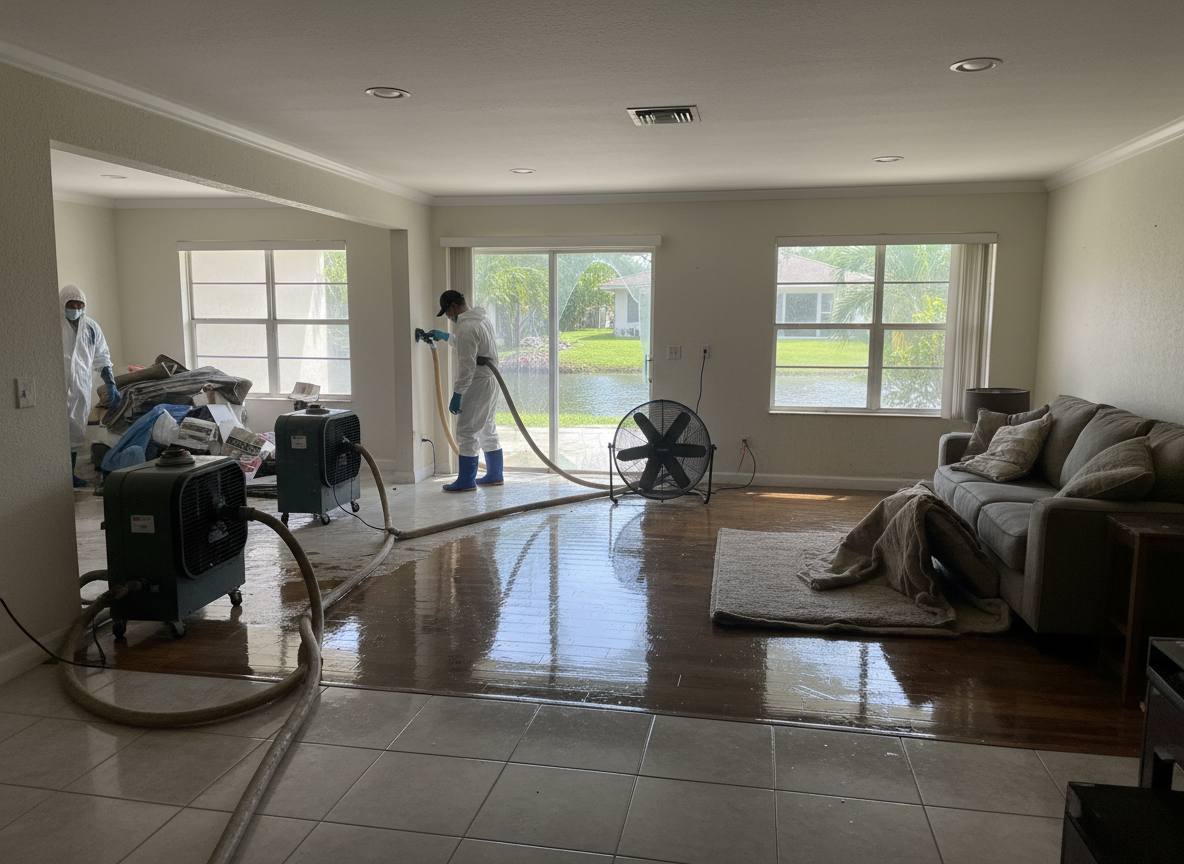
Oakland Park's water calls often arrive from the middle of the city, not the edges. The Florida East Coast Railway corridor, Dixie Highway and the older commercial strips sit on ground that was built over before modern drainage, and a heavy afternoon storm can leave water against a wall base on a block that looks perfectly flat from the street. This page explains how we scope water and mold work in Oakland Park.
What should an Oakland Park homeowner know about water damage?
Oakland Park is an 8.1 square mile city in Broward County with a 2020 population of 44,229, and about 8.4 percent of its area is water. It was first platted as Floranada, went bankrupt after the 1926 hurricane, and reincorporated in 1929 under the name it uses now. That history still shows in the housing and in where water goes.
A city that rebuilt after the 1926 hurricane
The 1926 hurricane bankrupted the original Floranada development, and the city that reincorporated three years later grew back on a street pattern laid out in the 1920s. That matters today for a simple reason: the drainage assumptions built into those blocks were made for a much emptier Broward County. Streets, swales and lot grades that worked when the surrounding land was open now receive runoff from fully built neighbours. When a storm stalls, water arrives from upstream lots and from the road, not just from the sky above your roof. We see this most often on the older blocks between the rail corridor and the Intracoastal side of the city, where a driveway can become the low point for three properties.
Housing from the 1920s core to post-war infill
The city's housing spans nearly a century. There are 1920s and 1930s cottages near the original core, post-war block ranches on the streets that filled in during the 1950s and 1960s, and later townhouse and condo clusters on land annexed into the city, including the Twin Lakes South and North Andrews Gardens areas. In one afternoon we can read a house with original galvanised supply lines, a 1970s addition with copper, and a 1990s bathroom remodel with PEX, all under one roof. Water finds the oldest joint first, but the stain often appears in the newest room, because that is where the finish is thinnest.
Rail, Dixie Highway and the drainage between them
The Florida East Coast Railway runs through Oakland Park parallel to Dixie Highway, and the corridor acts as a spine for commercial development and surface water alike. Parking lots, warehouse roofs and road surfaces shed rain quickly onto streets that were never sized for the volume. Where the ground is already saturated, that water ponds at the curb, backs into swales and sits against the wall of the nearest building. For a homeowner a block off the corridor, the practical consequence is a wet wall base after a storm that did not even produce a leak in the roof.
Who serves an Oakland Park address
Oakland Park is its own municipality, with City Hall at the Sky Building on Park Lane East, so building permits and local drainage questions run through the city. Broward County publishes the flood maps used for insurance and runs countywide emergency management, and the regional canal and drainage network is managed at the water management district level. If a flood-zone question and a permit question both come up, they are answered by different offices. We tell you what the building shows and leave the official determinations to the offices that own them.
What does an Oakland Park property need from water and mold work?
Most calls in this city fall into three groups: drying after storm runoff reaches a wall or floor, leak detection after wind-driven rain finds a roof or window edge, and remediation where an older cavity has stayed damp. The building decides which one applies.
- Water restoration covers extraction and the drying and repair work that follows. In Oakland Park the complication is often the mix of eras in one house, where a leak in a 1950s block wall surfaces next to a 1990s addition.
- Storm damage covers wind and rain intrusion, from a lifted roof edge to a window track that no longer drains, plus the leak detection that finds the path before a wall is opened.
- Mold remediation is the right call where growth is visible or a wall base has been damp long enough that the paper and studs are affected. Containment and removal come before any source correction.
Many jobs here start with storm runoff at a wall base and end with a source repair that belongs to a plumber or a roofer. The scope separates those from day one, so drying is not confused with rebuilding.
Why choose a Fort Lauderdale crew for an Oakland Park job?
Our base at 708 SE 32nd St in Fort Lauderdale is about five miles from Oakland Park, and we work in the city's housing every week. That matters because the stock is not uniform: a 1920s cottage, a post-war ranch and a 1990s townhouse each fail differently, and the drying plan has to follow the assembly rather than a template. We read moisture before we remove anything, write the scope before work starts and put the hand-off to other trades in writing. We do not list licence numbers, certifications or customer reviews on this site, and we will not manufacture them.
Why Oakland Park water damage should not wait for the weekend
Runoff that reaches a wall base is often shallow and easy to ignore, which is exactly why it causes problems. The water does not need to be deep to be absorbed by drywall, baseboard and the paper facing on a stud. Once those materials are wet, South Florida humidity keeps them wet, and a slow storm on Tuesday can leave a wall cavity damp into the following week. Oakland Park also sits in a rainfall pattern where a second band arrives before the first has drained, and the ground has no capacity left to absorb it. Waiting also changes what can be saved: a baseboard and a section of drywall dried this week are a baseboard and a section of drywall you do not replace next month.
What should an Oakland Park homeowner check before the next storm?
Most of the calls we take in Oakland Park could have been found with an afternoon of looking. These are the four checks that matter most in this city's housing.
Look at how water leaves your block. Oakland Park is built out, and a lot of runoff arrives from neighbouring properties and the commercial corridors. Stand outside during heavy rain and watch where the water goes: if it crosses your drive and sits against the wall, no amount of interior drying will stop the next event. Clear the swale, check the grade and keep the low point clear.
Press the baseboards in the oldest rooms. A 1920s cottage or a 1950s ranch usually has one wall that faces the weather. A soft baseboard with no stain above it means the wall base is wet from outside, not from a pipe. That is a different repair from a leak, and it needs the grade and the drainage looked at as well as the wall.
Check the junction where the addition meets the house. Enclosed porches, converted carports and rear extensions are where water moves from one era of construction into another. Look for a hairline crack in the paint, a swollen casing or a gap in the sealant at that seam.
Watch the roof edge after wind. Lifted tabs, granules in the gutter and a ceiling stain that grows after each storm are the three signs of an edge that has started to fail. Photograph the stain before you cover anything.
If the water came from outside, the source is the ground and the grade. If it came through the roof or a wall, the source is the envelope. Getting that distinction right before you call saves a wasted visit.
How an Oakland Park job runs, step by step
Every job starts with the question of how the water got in, then moves through drying, documentation and a written hand-off. We do not open a wall before we have read it.
- Call and describe what you see. Tell us where the water is, whether it came from the ground, a roof or a fixture, and how long it has been there. We explain what to keep clear before the crew arrives.
- Read the building. Moisture readings at marked points, a thermal scan where the wall or ceiling is suspect, and a comparison against a dry reference of the same material.
- Stop the source and protect the rooms. Water is shut off where it is safe, contents are moved clear, and containment goes up where growth or contamination is present.
- Extract, remove and dry. Standing water and saturated material come out, then air movers and dehumidifiers run against recorded readings rather than a fixed number of days.
- Verify and hand back. We compare final readings with day one and list the repairs that belong to a plumber, roofer or general contractor.
What's included on an Oakland Park job:
- A written scope separating emergency water work from permanent repairs
- Moisture readings at marked points, photographed and repeated at the same locations
- Extraction of standing water and removal of saturated pad, carpet or drywall
- Air movers, dehumidifiers and cavity drying set to the assembly in front of us
- Containment and HEPA filtration where growth is present or likely
- Photographs and a moisture log for your insurer, landlord or property manager
- A hand-back walkthrough with day-one and final readings side by side
What's the next step in Oakland Park?
Call (954) 707-5047 and describe the water: where it is, when it appeared and whether it came from the ground, a wall or above. We will tell you what to shut off if it is safe, what to keep clear, and what the first visit will cover. If the source is a roof, a window or a plumbing line, we will say so before you book.
Around Oakland Park
We regularly work near:
- 📍Dixie Highway
- 📍Florida East Coast Railway
- 📍Middle River
- 📍Cypress Creek
- 📍Fort Lauderdale
- 📍Wilton Manors
Mold Remediation in Oakland Park — Local Notes
- •2020 population 44,229; 8.1 square miles
- •Became Oakland Park in 1929 after the Floranada bankruptcy
- •Bisected by the Florida East Coast Railway