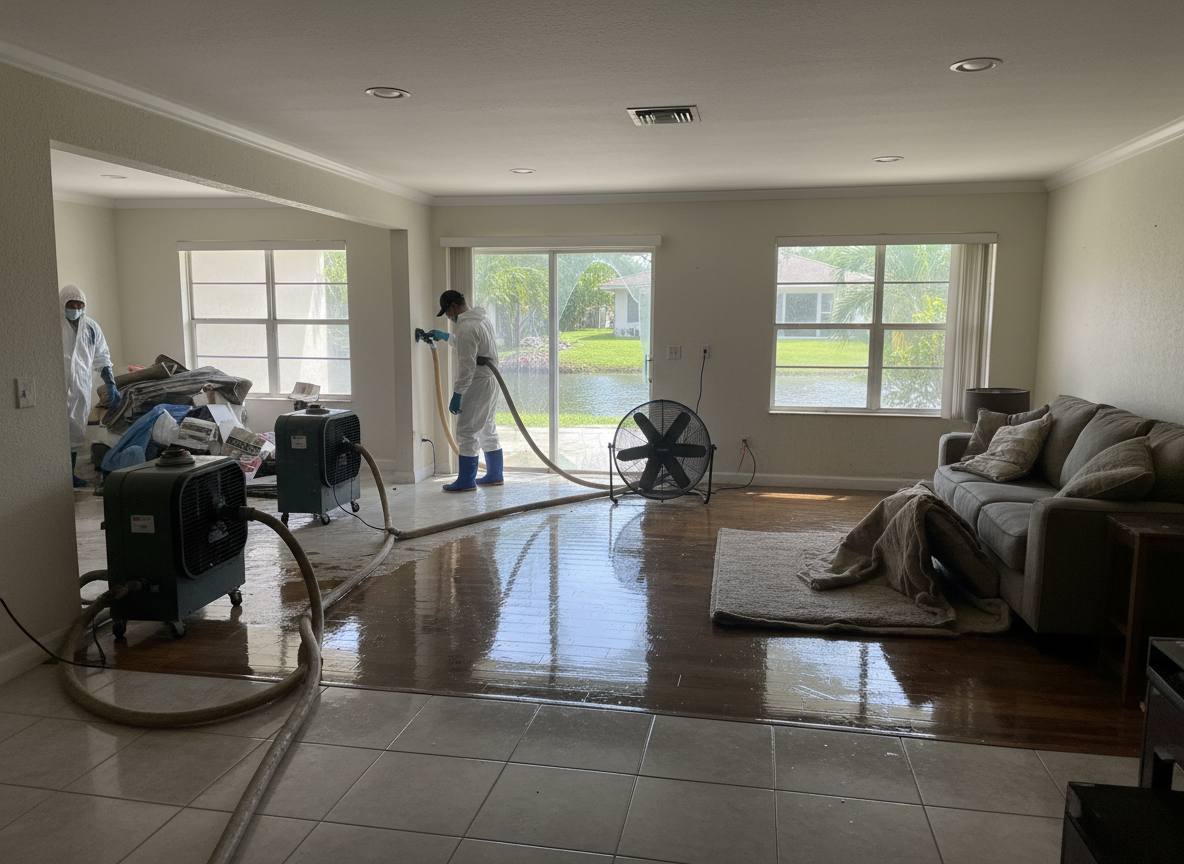
Lauderdale-by-the-Sea is a barrier island town where the ocean is on one side, the Intracoastal is on the other, and salt air reaches every fastener in between. Water problems here are shaped by that setting: tidal flooding that arrives without rain, wind-driven rain that finds mid-century window frames, and air-conditioning condensate that has been dripping into the same wall since the building opened. This page covers how we scope work in the town.
What makes water damage in Lauderdale-by-the-Sea different?
Lauderdale-by-the-Sea is a 1.57 square mile town in Broward County with a 2020 population of 6,198. Of that area, 0.876 square miles is land and 0.694 square miles is water, about 44.2 percent. The town sits on a narrow barrier island, separated from the mainland by the Intracoastal Waterway and connected by a single drawbridge at Commercial Boulevard.
A barrier island where 44 percent of the town is water
On an island this narrow, there is very little ground to absorb rain and almost no elevation to work with. During the autumn king tides, water comes up through the Intracoastal and the storm drains and stands in low streets without a cloud in the sky. During a tropical system, the same water arrives with wind behind it. A ground-floor unit can take water at a door threshold while the roof is sound and the plumbing is fine. That is a different problem from a burst pipe, and it needs a different record: where the water line stopped, how long it stood, and what it touched.
Mid-century buildings and plumbing that has been in service since
Much of the town's building stock dates from the 1950s and 1960s, including the mid-century modern hotels and small condo buildings that give it its character. Those buildings were designed for a different era of plumbing and waterproofing: copper and galvanised supply lines, cast-iron drains, flat or low-pitch roofs, jalousie openings replaced over time with sliding glass, and window frames set into block walls with sealant rather than modern flashing. A leak in a building like this often starts at a joint that has been repaired twice already. We read the wall and the ceiling plane before assuming the source is where the stain is.
One drawbridge, one road in, and equipment that has to fit
Access shapes a job here more than in almost any other Broward city. Commercial Boulevard crosses the Intracoastal on a drawbridge, and A1A runs the length of the island, so a crew and its equipment arrive by one route. Buildings set back behind a lobby, a pool deck or a narrow side street can mean a long hose run or a portable rather than truck-mounted setup. In a multi-storey building, the elevator, the service door and the association's work hours decide when material can be carried out. We plan that before the crew leaves, not on arrival.
Who serves a Lauderdale-by-the-Sea address
Lauderdale-by-the-Sea is its own municipality, so building permits and local right-of-way questions run through the town. Broward County publishes the flood maps used for insurance and runs countywide emergency management, and the regional canal and drainage system is managed at the water management district level. Work on a seawall, a dock or the coastal edge can also involve state environmental permitting, which is a separate process again. We document the building and leave the official determinations to the offices that own them.
What does a Lauderdale-by-the-Sea property need?
Three things come up most often on the island: tidal or storm water at a ground-floor threshold, wind-driven rain finding an old window or roof joint, and condensate or supply-line leaks inside mid-century walls. The building type decides the scope more than the town does.
- Water restoration handles extraction and the drying and repair work that follows. On the island it usually starts with a water line recorded at the door or wall base, because a tidal flood and a plumbing leak are documented differently.
- Storm damage covers wind and rain intrusion, roof edges, window frames and lanai ties, with leak detection built into the service rather than sold separately.
- Mold remediation applies where a wall or ceiling has stayed damp long enough for growth. In a 1960s building, that is often a cavity behind a bathroom wall or a ceiling pan above a corridor.
A single island job can involve all three in sequence: tidal water at the door, a window that no longer seals, and a wall cavity that stayed damp after both. Separating them early keeps the scope honest.
Why use a Fort Lauderdale crew on the island?
Our base at 708 SE 32nd St is about seven miles from Lauderdale-by-the-Sea, and the route is straightforward: south to Commercial Boulevard, east over the drawbridge, then onto A1A. We work in mid-century buildings every week, which means we expect copper and galvanised lines, cast-iron drains, flat roofs and window frames set into block. We also plan access before we arrive, because a truck that cannot reach the building changes the equipment list. We do not publish licence numbers, certifications or reviews here, and we will not invent them.
Why island water damage gets worse faster
Salt air and constant humidity mean an island wall dries more slowly than the same wall inland. A damp cavity behind a bathroom wall in a 1960s building can stay damp for weeks without ever feeling wet to the touch, and the building's air conditioning keeps the surface cool, which adds condensation to the moisture already there. Add king tides in the autumn and a hurricane season that runs from June through November, and the ground floor of an island building can take water more than once in a season. Material that is dried properly after the first event is material you still have for the second.
What should an island homeowner check before the next storm?
On a barrier island, preparation is mostly about access and thresholds. These four checks are the ones that make a difference in Lauderdale-by-the-Sea.
Know your floor level relative to the street. A ground-floor unit that sits a few inches below the road takes water first. If you know the difference, you know when to move boxes, electronics and anything on the floor out of the way. King tides in the autumn can bring water up without rain, so the tide table is as useful as the forecast.
Check door thresholds and window seals. Water on an island arrives sideways. Look at the sealant around window frames, the condition of door sweeps and the drainage path at balcony and patio doors. A track that no longer drains holds water against the wall until it finds a way in.
Clear the condensate line and the pan. In a mid-century building the air handler is often in a closet or above a corridor ceiling. A blocked line wets the pan, the platform and the ceiling below, and nobody notices until the corridor stains.
Plan how a crew would reach you. Commercial Boulevard crosses on a drawbridge and A1A is the only route along the island. If your building has a lobby, a pool deck or restricted parking, think about where equipment could be staged and who would authorise access. That conversation is easier before an emergency than during one.
Salt air also ages fasteners and sealant faster than inland, so a joint that was fine two seasons ago may not be fine now. Check the fixings, not just the panels.
How an island job runs, step by step
Every job starts with the water line and the source, then moves through drying and documentation to a written hand-off. Access and containment are planned before anything is carried in.
- Call and describe the water. Say whether it came up from the ground, in through an opening or down from above, and whether the building has a manager or association contact.
- Plan access and read the building. We confirm parking, the elevator or stair route and the work hours, then take moisture readings at marked points and scan concealed areas.
- Stop the source and contain the work. Water is shut off where it is safe, contents are protected and the work area is sealed where growth is present.
- Extract, remove and dry. Standing water and saturated material come out through a protected route, then air movers and dehumidifiers run against daily readings.
- Verify and hand back. Final readings are compared with day one, and the repairs that belong to another trade are listed in writing for you and the building.
What's included on a Lauderdale-by-the-Sea job:
- A written scope separating emergency water work from permanent repairs
- Moisture readings at marked points, photographed and repeated at the same locations
- Extraction of standing water and removal of saturated pad, carpet or drywall
- Air movers, dehumidifiers and cavity drying set to the building's construction
- Containment and HEPA filtration where growth is present or likely
- Protected routes for carrying material out through a lobby, corridor or elevator
- Photographs and a moisture log for an owner, association or insurer
- A hand-back walkthrough with day-one and final readings side by side
What's the next step in Lauderdale-by-the-Sea?
Call (954) 707-5047 and describe the water: where it is, when it appeared and whether it came from the ground, a window or above. Tell us if the building has a manager or an association so we can plan access. We will explain what the first visit involves before you book anything.
Around Lauderdale-by-the-Sea
We regularly work near:
- 📍Commercial Boulevard
- 📍State Road A1A
- 📍Intracoastal Waterway
- 📍Sea Ranch Lakes
- 📍Pompano Beach
- 📍Fort Lauderdale
Mold Remediation in Lauderdale-by-the-Sea — Local Notes
- •2020 population 6,198; 44.2 percent of the town is water
- •Barrier island reached by one drawbridge at Commercial Boulevard
- •Housing stock includes 1950s and 1960s mid-century buildings