2026-10-18T11:38:03.284Z ·
Why Fort Lauderdale Homes Stay Wet After the Rain Stops
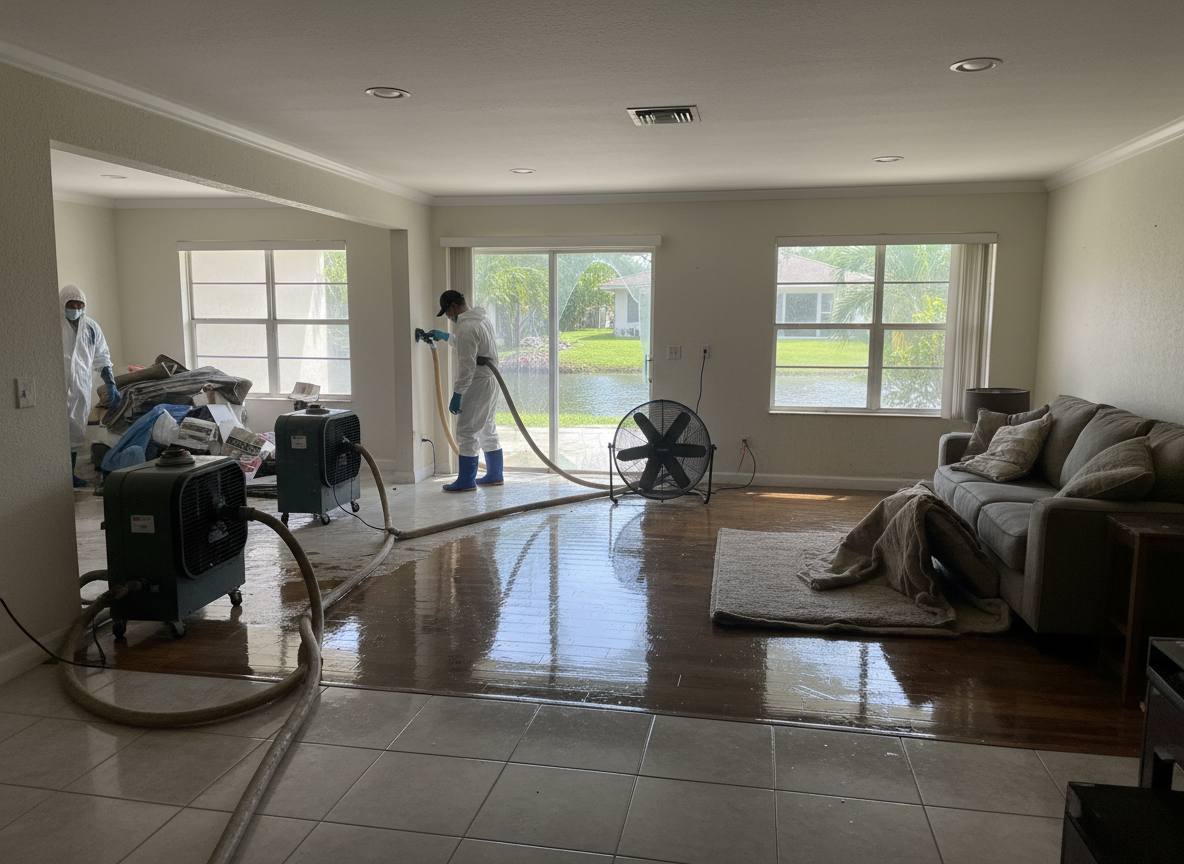
A Fort Lauderdale house can look dry two hours after a storm and still be holding water in three places. That gap between what you can see and what is actually wet is why mold calls arrive a week after the rain rather than on the day of it.
The water you see is the least important part
Standing water in a room is obvious and usually dealt with quickly. The water that causes lasting damage is the water that has moved sideways: under a tile floor, into the base of a wall, behind a cabinet, along the top plate of an exterior wall, or into the ceiling cavity above a room you thought was unaffected. Once it is in those places, it does not evaporate in South Florida humidity. It sits, and the materials around it stay damp.
Where Fort Lauderdale homes hide water
The slab edge. Most Fort Lauderdale houses sit on a slab with no basement and no crawl space. Water that reaches the slab from outside has nowhere to drain, so it wicks up into the bottom plate of the wall and into the base of drywall, baseboard and cabinets. A damp baseboard with no stain above it is the classic sign.
Stucco over block. A stucco wall can hold moisture in the scratch coat and the block behind a finish that looks perfect from both sides. A pin meter on the painted interior can read low while the exterior face and the block core are wet. That is why an inspection that only looks is not enough on a house of this age.
The ceiling cavity. Water entering at a roof edge, a window head or a lanai tie-in travels along a joist or a slab soffit before it stains a ceiling. The stain appears where the water stopped, not where it entered. Cutting out the stain without finding the entry point leaves the wet insulation and the same joist feeding the same problem.
The air-handler closet. In this climate the air conditioning runs for most of the year and produces condensate every day. A partially blocked drain line backs water into the pan, and the overflow lands on the platform, the closet floor and the ceiling below. It is a small, boring failure that quietly wets the same assembly for months.
Why waiting feels reasonable and is not
After a storm, the street drains, the power comes back and the house looks normal. Nothing beeps. The instinct is to wait for the weekend, or for the insurance adjuster, or for a contractor who is not busy. In a dry climate that might be fine. Here, the air is close to saturated for much of the year and a wet wall cavity does not dry on its own, even with the windows open. Warm, humid air plus wet paper-faced drywall is exactly the condition mold needs.
Delay also changes what can be saved. Baseboards, drywall, cabinet bases and flooring that could have been dried are removed and replaced instead. A contained drying job in one room becomes containment in two rooms with contents packed out. The cheapest water job is the one that starts while the material is still salvageable.
What to check yourself before you call anyone
Look at the base of the walls in the rooms that took water, especially on the side of the house the weather came from. Press the baseboard and the drywall just above it; a soft or spongy feel matters more than a discoloured surface. Look at the ceiling below any bathroom, air handler or roof valley, and photograph any ring even if it looks old. Check the air-handler closet for water in the pan and dampness on the platform. And notice smell: a musty edge when the air comes on is information, even when nothing is visible.
If you find water, the first step is to stop the source if that is safe and keep people away from wet ceilings and water near outlets or panels. Then get the affected area read with a meter rather than judged by eye. A reading at a marked point, compared with a dry reference of the same material, tells you whether the assembly is wet and whether it is drying. That is the difference between a house that is dry and a house that merely looks dry.
A final note on sequence. If the water came from a roof, a window or a plumbing line, the source repair belongs to a roofer, a glazier or a plumber. Drying the interior before that repair is finished is wasted work, and drying it afterwards without documenting what was wet leaves you with no record. Source, dry, document, hand back. In that order, a storm becomes a repair instead of a remediation.